A simple intro to CBT: How to retrain your unhelpful thoughts
If you are new to My Monkey Mind and CBT, you may find it helpful to first read What is My Monkey Mind?, where you will find a personal introduction to the journey ahead at My Monkey Mind.
Before we delve into CBT, let’s start with a scenario… I want you to think of a situation where you felt nervous, scared or anxious. Now ask yourself… “What thoughts were popping up as I was in this situation?”
- Was the Monkey loud and wanting your attention by planting what if thoughts?
- Were your thoughts negative?
- Did your thoughts enhance how you was feeling?
So now you got all these thoughts whirling around sending you into a bit of a spiral, what physical sensations were you experiencing?
- Were you shaking or your heart palpitations getting stronger?
- Were you sweating or feeling a bit nauseous?
- Did you have an upset stomach and frequent toilet visits?
Now you’re really feeling it. Your thoughts are loud and spiralling, your emotions are getting worse and now you are experiencing physical sensations, what more do you want? Ah.. behaviours? So what happened next? How did you behaviour in this situation?
- Did you withdraw and isolate yourself?
- Were plans cancelled?
- Did you overthink and procrastinate?
- Did you just run from it?
Yep I hear you… now you feel silly that you let your Monkey take control. We’ve all been there, and this is where Cognitive Behavioural Therapy becomes a powerful tool to managing your Monkey Mind. Let’s delve deeper shall we?
What is CBT?
In simple terms… CBT also known as Cognitive Behavioural Therapy. ‘Cognitive’ for how we think and ‘Behaviour’ for how we respond/act. It’s a type of talking therapy that can be used for different type of psychological issues, not just for one, such as Anxiety, Depression, Confidence, Stress and so on. It can also support you when developing new habits such as exercising, eating better, and creating healthier lifestyle choices.
CBT allows you to retrain unhelpful thoughts and rebuild new helpful thought patterns known as Cognitive restructuring. Unhelpful thought patterns can become self disruptive and negatively impact you in multiple ways, such as low confidence, low self belief, low self esteem, loneliness, and depression.
It’s not the case of changing negative thoughts into a positive thoughts. Positive thoughts have just as negative impact as a negative thought can have, also known as being in denial. It’s important to understand your mind and thought processes to be able to manage situations.
By rebuilding the new helpful thought pattern, it considers both the negative and positive thoughts and finds the middle ground between them. The middle ground is where there is less negative reactions (emotions, behaviours and physical sensations) but also not living in denial and the rainbow and fairy world where everything is going to be ok. Let’s face it, life has it’s ups and downs no matter how positive we think.
The Hot Cross Bun Model
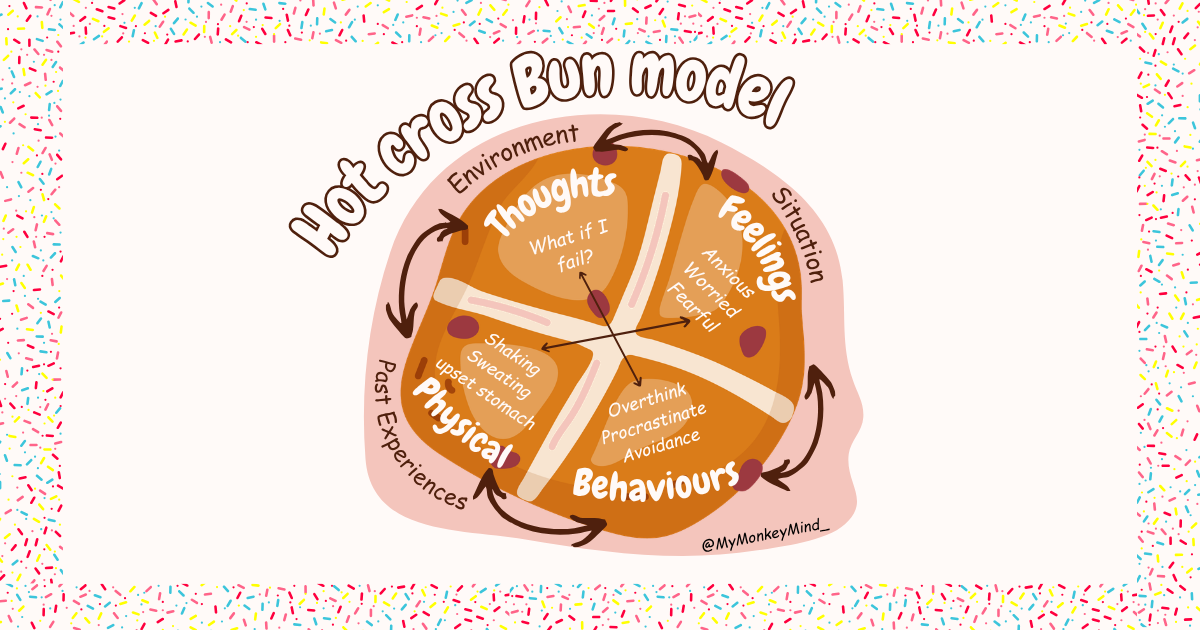
Majority of the people think of CBT as the triangle where your thoughts affects your feelings, your feelings then affect your behaviours and repeat. However, what if I tell you it’s a little more complex than that? I like to refer to CBT as the Hot Cross Bun Model (no it doesn’t just appear on Easter, that the little sweet treat, hear me out).
Below is a diagram that simply explains the cycle of CBT in the Hot Cross Bun Model
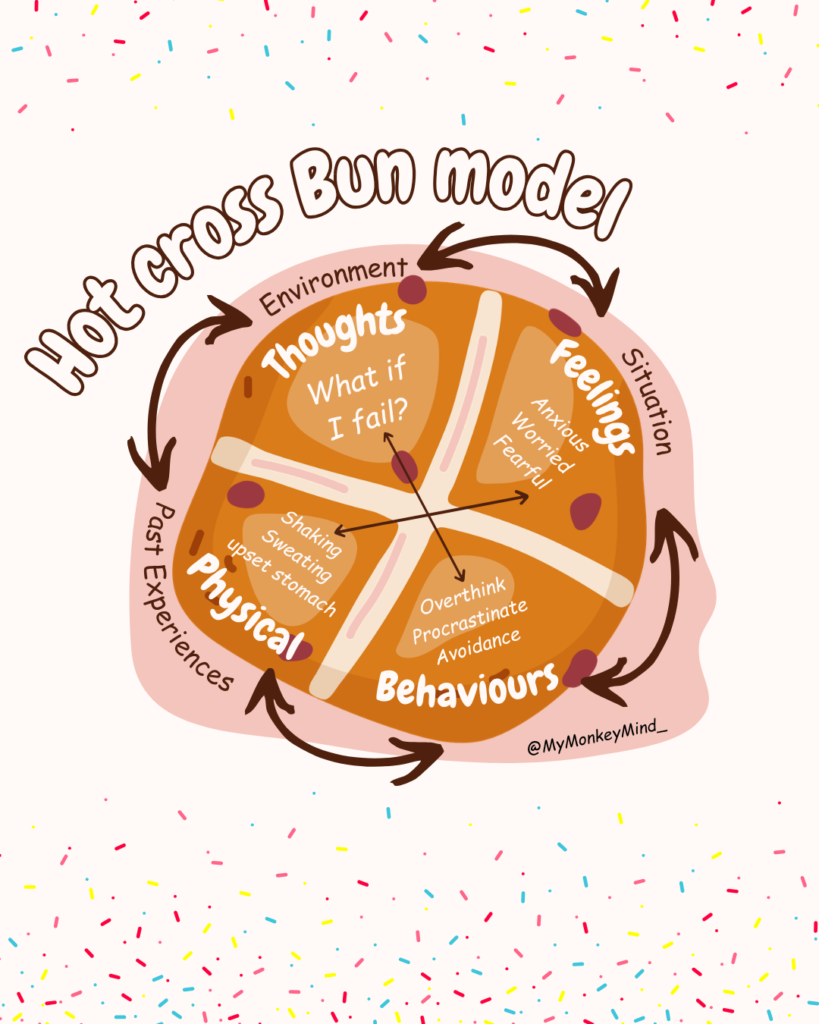
There are four components to CBT: Thoughts, Feelings, Behaviours and Physical Sensations which are all triggered by a situation, the environment or past experiences. Each one of these can trigger your monkey and it doesn’t have to start with a thought.
How many times have you done or said something and later on replayed it back in your mind and started to question it and overanalyse and ruminate? Then the cycle starts, it triggers your emotions, physical sensations are starting, your monkey is going into a spiral of thoughts all from one behaviour.
Perhaps it did start with a thought because your going somewhere new and facing the unknown, or maybe you are sweating loads and it’s triggering you to feel embarrassed, thoughts are popping up of what others are thinking and so forth.
As you can see, there is not one direct line like a triangle, there are multiple ways in how your negative thoughts can affect you. Your thoughts, feelings, behaviours and physical sensations are all inter-linked and affected by each other in different ways.
CBT in Everyday life
Therapy doesn’t have to involve a sofa, a Therapist or a box of tissues, it can be experienced in different ways and CBT embraces that. You can use CBT throughout your everyday life and no one would even know you are using it, it’s all in your mind (The irony hey!).
Here are just a few situations that you could implement CBT into your everyday life. You could be:
- in work or school, anxious, stressed and imposter syndrome is loud.
- going to a new place (school, work, restaurant, holiday etc)
- shopping, exercising, driving, walking
- going to an event or a meeting to attend
- doing something new – new job, new home, new hobby, new travel arrangements
- doing things solo – a holiday, day trip, living on your own, travelling
- struggling to get up in the mornings or going to sleep
- something is out of your control – traffic jams, cancelled transport or plans.
The list is endless but the point is, you can use CBT anywhere and in any situation where you thoughts, feelings, behaviours, physical sensations become triggered. There is no right or wrong way to implement CBT as long as you are retraining your thought processes in a helpful way.
CBT is a part of my everyday life and no one even knows it. It’s discreet, quick and simple and you can still live each day to your best. It has allowed me to become more self aware of myself and my thoughts, I have taken back control of my everyday life and now beginning to face the unknown and step outside the comfort zone. This change is all down to being consistent with my retraining my thoughts and riding the anxiety wave!
A simple CBT exercise to try today
I like to play a game with my thoughts. I call it ‘Thoughts in Court’. You can play this in your head or write it down as part of a little journaling activity.
For this game, you are putting the unhelpful thought on the stand, and you become the jury. This game allows you to separate your thoughts from you as a person and it’s broken down into 3 steps.
Step one: Acknowledge the thought
This step desensitises the thought and creates the separation between you and the thought. It makes the thought feel less scary and dominant, and that you are the one in control.
- What is the thought?
- Give the thought a name.
For example, “Hey Monkey, I hear the thought – What if I get lost?”
Step two: Examine the thought
This step allows you to rationalise the thought. It gives you some context to the thought and delve deeper into why the thought is popping up and if the thought is true or not.
- Do you have any evidence to make this thought true?
- What has triggered this thought?
- What part of the situation can you control?
For Example, “Ok, I know I got lost last time going to a new place, nothing bad happened to me. I still got to the place and I’ve learnt from the mistakes that I made. This time I’m going to plan the route before I leave .”
Step three: Reassure the thought
Now we have desensitised and rationalised the thought, we can give the thought some reassurance. This is where your mind starts to feel a little calmer, your nervous system is starting to regulate again. Your mind is like a baby, so treat it like one. Nurture it. Reassure it. Hold it’s hand every step of the way.
- Give your monkey the reassurance
- Be kind to your monkey mind
For example, “We can do this Monkey, It’s going to be an adventure. Nothing bad is going to happen, if I get lost again I have my satnav and I can reroute or go back the way I came until I have familiarity. I am going to leave in plenty of time so I won’t be rushing.”
Once you’ve completed each step, you’ve started to do some cognitive restructuring to your thoughts. Keep repeating this game, your mind is like a muscle you got to keep working at it and be consistent so that you can see the results!
So there we have it, CBT has been simplified. It doesn’t seem that scary after all does it? Therapy doesn’t have to involve sitting on the sofa, crying your eyes out. Therapy can be fun and experienced in different forms that suits you.
Let me know in the comments what thoughts you have put in court and the outcome you came to.
Medical Disclaimer: The information on My Monkey Mind is for educational purposes only and is not intended as medical advice or a substitute for professional diagnosis, treatment or support. If you have concerns about your mental or physical health, please consult a qualified healthcare professional.